THE SHORT VERSION
- SaaS mode lives only on HighLevel's $497-a-month Agency Pro plan. It is not on Unlimited, and that $497 is fixed whether you resell to two clients or twenty.
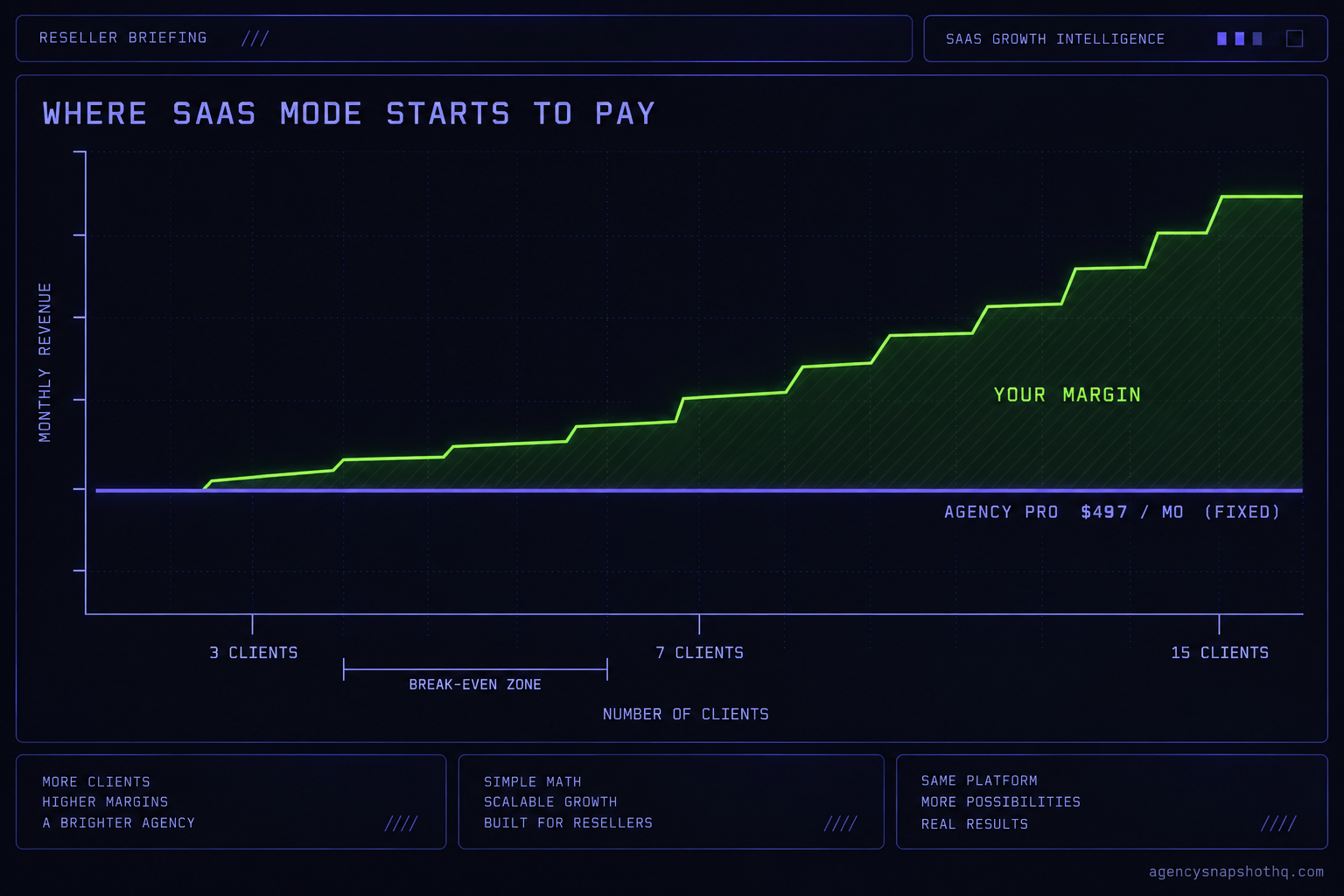
- Because the platform cost is fixed, your SaaS margin is driven by how many clients subscribe, not by what you charge each one. At a handful of seats the $497 eats your spread; the model only turns profitable once that fixed cost amortises across enough clients.
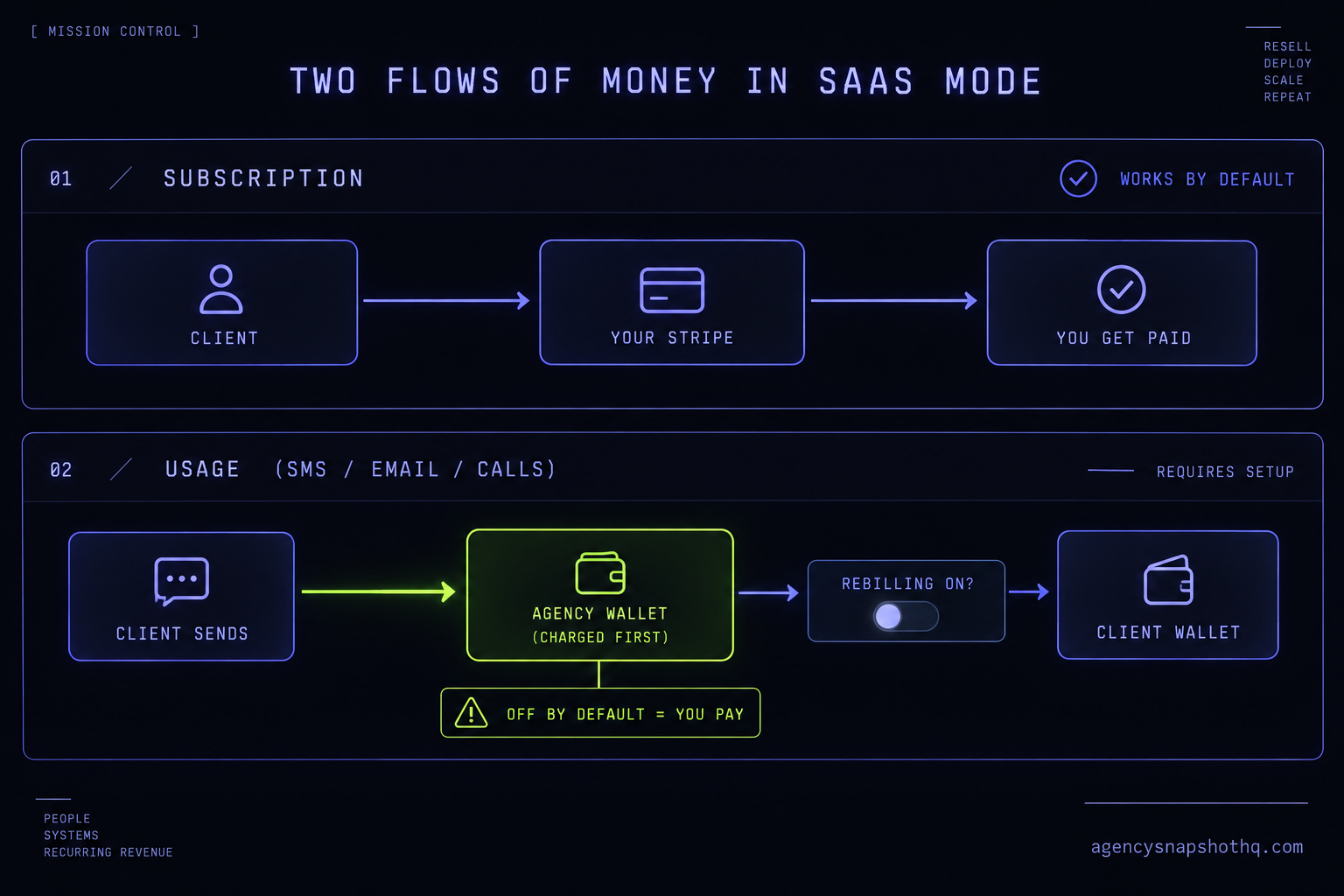
- Usage for SMS, email and calls always charges your agency wallet first. If you never switch on rebilling and fund the client's wallet, you silently pay your clients' usage bills on top of the subscription you sold them.
- Every SaaS signup lands on whatever snapshot you attached in the Plan Configurator. Attach a finished, per-niche build or the client logs into a blank account and churns in the first week.
- Turning SaaS mode off on a client is not a pause button. It cancels the subscription and permanently deletes the wallet, so treat it as a one-way door.
The operator on the call had flipped SaaS mode on four weeks earlier and was now reading his first full HighLevel invoice out loud, trying to work out where the money went. Three clients, each paying him through his own branded signup page, each on a plan he had priced himself. On paper that was recurring revenue with his logo on it. Then the line items: the Agency Pro subscription, and under it a run of usage charges for SMS and email that he did not recognise as his own. “These are my clients’ texts,” he said. “Why are they on my bill?” They were on his bill because he had never switched on rebilling, and the wallet that funds usage was still his. His three-client software company had spent its first month running at a loss, and he was sitting in the plan configurator deciding whether to raise his prices, switch something on, or quietly turn the whole thing back off.
That call is the reason for this briefing. Selling GoHighLevel as your own software, under your own brand, is a real business and some agencies make it their whole business. But it is not a switch you flip for extra margin on an account you already run. It is a second product with its own fixed cost, its own billing plumbing, and a failure mode that bills you for other people’s usage without ever sending you a warning. This piece walks the money through that plumbing: what the $497 actually buys, where the margin really comes from, the four places resellers lose money, and the arithmetic at three, seven and fifteen clients so you can run your own numbers before you commit.
What SaaS mode actually is, and what the $497 buys
SaaS mode is the set of features that turns a GoHighLevel agency account into a product you resell. Instead of installing the platform for a client and charging a setup fee, you publish a plan, a client signs up through a page carrying your brand, a sub-account is created for them automatically, and they are billed every month by your Stripe account rather than invoiced by you. To them it is your software. The fact that HighLevel is underneath is never shown.
The first thing to get straight is which plan this lives on, because it is the number that sets the floor under every pricing decision you are about to make. The HighLevel plan ladder runs Starter at $97 a month, Unlimited at $297, and Agency Pro at $497. SaaS mode, the plan configurator, white-label signup and markup rebilling all sit on Agency Pro. Unlimited will let you pass usage through to a client at cost, but it will not let you build and sell branded plans with a markup. So the working assumption for a reseller is simple and fixed: $497 a month, every month, before a single client has subscribed. Paid annually that comes down to roughly $414 a month, a little under $4,970 for the year. Every plan carries a 14-day free trial, which is long enough to build and test but not long enough to validate demand, so do not treat the trial as your proving period.
The plan configurator is where the product is defined
Inside Agency Pro, the SaaS mode setup guide walks through a plan configurator, and that screen is where the commercial decisions actually get made. For each plan you set the monthly price, choose a trial length, decide how much Twilio and email credit is included, and, the part most new resellers skim past, attach a snapshot. That snapshot is the product. When a client signs up, the sub-account that gets created is built from whatever snapshot you attached, which means the quality of that build is the quality of the thing you just sold. Attach a finished, niche-specific account and the client logs in to something that works on day one. Attach an empty one, or a generic one wired to custom values that were never filled, and the client logs in to a blank screen and starts counting the days to their first invoice.
This is the quiet link between SaaS mode and everything else an agency buys. In a done-for-you model, a weak build costs you a support ticket. In a SaaS model, a weak build costs you the subscription, because the client cancels and the recurring revenue you were counting on never compounds. The build matters more here, not less.
White-label is the part clients are paying for
The other half of what the $497 buys is the branding. A rebranded login domain, your logo in the interface, your name on the signup and billing emails. For a client who does not know or care what GoHighLevel is, that branding is a large part of what they believe they are buying: a tool that belongs to the agency they already trust. It is also the part that is easy to get wrong in a way that undercuts the whole model, because a client who stumbles onto a stray HighLevel logo, an unbranded help article or a calendar invite from a domain they do not recognise has just learned that the software is not really yours. Finishing the white-label pass is not cosmetic. It is the difference between selling a product and reselling a login.
How the money moves: plans, wallets and rebilling
Now the plumbing, because this is where the operator on the call lost his first month. There are two separate flows of money in a SaaS setup, and they behave differently.
The first flow is the subscription. The client subscribes to the plan you built, and your Stripe account charges them that monthly price directly. This part is intuitive and it is the part everyone sets up correctly, because nothing works until it does. The money lands in your account and HighLevel takes its platform cut through your $497 plan, not per client.
The second flow is usage, and it does not behave the way the subscription does. Every text, every email, every minute of calling that a client’s sub-account generates has a real cost, and by default that cost charges your agency wallet. The reselling and rebilling documentation is blunt about the order of operations: usage charges the agency wallet for sub-account usage, and the client is only charged if rebilling or reselling has been enabled. Read that twice if you are about to turn SaaS mode on. The default is that you pay. Rebilling is the thing you switch on to make the client pay instead, and once it is on, the client funds their own wallet, sees their balance and usage under their company billing settings, and tops it up on a schedule you set. You can also add a markup on that usage inside the configurator, so the usage line can be a small profit centre rather than a pass-through, but the markup is optional and the mechanism is the same either way. What is not optional, if you do not want to eat your clients’ usage, is turning rebilling on in the first place.
V1, V2 and the one-way door
There is one more detail worth knowing before you build, because it is the kind of thing that is cheap to decide up front and expensive to change later. SaaS billing comes in two generations. The older version is Stripe-only and configured once at the agency level. The newer version supports several payment providers and is configured per sub-account, which matters if your clients want to pay by a method Stripe does not cover. A single sub-account can only run one of the two at a time, so pick the model that matches how your clients actually pay before you onboard the first one.
And treat the off switch with respect. Disabling SaaS mode on a client does not pause them. It cancels the subscription and permanently deletes the wallet along with its balance. If you need to hold a client for a month, adjust their plan or pause the subscription from inside billing. Reaching for the SaaS toggle to do it is how resellers accidentally destroy a paying client’s account and their own payment history in one click.
Where SaaS-mode reselling breaks
Four failure modes account for most of the money that resellers lose, and none of them announce themselves. Each one looks fine right up until the invoice or the cancellation arrives.
You pay your clients’ usage without knowing it
This is the one from the opening call, and it is the most common. You stand the SaaS plan up, the subscription charges correctly, clients start sending texts and emails, and because the subscription side looks healthy you never check the usage side. The usage has been charging your agency wallet the whole time. You find it when the wallet auto-recharges off your card for an amount that has nothing to do with your own sending, or when you finally read the invoice line by line the way the operator on the call did. The fix is to enable rebilling in the configurator and confirm each client’s wallet is funded before they start sending, not after. The failure is silent because everything that is supposed to make noise, the subscription, is working.
You turned it on with too few clients
The $497 is fixed. That sentence is the whole failure mode. A reseller who flips SaaS mode on with two or three clients has added a $497 monthly cost to serve a roster that cannot yet carry it, and the spread between what those clients pay and what the platform costs can be thin or negative once you account for the build time. SaaS mode is not a feature you enable to see if it works. It is a cost you take on when your pipeline already justifies it. Turning it on early does not grow the business faster, it just moves the break-even further away. The arithmetic in the next section shows exactly where this flips.
The snapshot behind the plan was not finished
A SaaS signup is only as good as the snapshot attached to it, and a client who signs up to a build that was never completed does not file a support ticket. They cancel. In done-for-you work you get a chance to fix a half-wired account because you are in the room. In SaaS the client onboards themselves, hits a workflow that points at a custom value that was never created or a calendar still wired to somebody else’s account, decides the software is broken, and churns before you even know they struggled. The snapshots worth attaching to a SaaS plan are the ones that are genuinely finished per niche, which is why a reseller’s snapshot library is a different purchase from a one-off build. A custom snapshot build scoped specifically as a SaaS product, or a finished catalogue snapshot like the Digital Marketing Agency Snapshot for a reseller serving agencies, is the asset that keeps the cancellation rate down.
You priced the plan without counting the platform
Resellers coming from a services background tend to price a SaaS plan the way they price a retainer, by looking at the value to the client, and forget that the platform cost sits underneath every subscriber regardless of how few there are. A $97 plan sounds like a clean reseller price until you remember that your first subscriber is carrying the entire $497 alone. Pricing has to start from the fixed cost and the number of clients you can realistically sign in the first quarter, not from what the market will bear per seat. The seat price is the easy half. The seat count is the half that decides whether you make money.
The arithmetic: what you net at 3, 7 and 15 clients
Here is the model, laid out so you can drop your own numbers into it. The point of the exercise is to show that SaaS margin moves with client count far more than it moves with client price, because the biggest cost on the sheet does not change when you sign another client.
Start with the fixed cost. Agency Pro is $497 a month, or about $414 a month if you pay for the year. Call it $497 for a reseller who is still ramping and not ready to commit annually. That number does not move, so it goes at the top of the sheet and stays there.
Next, the revenue. This is your assumption, not mine, so substitute your own. For the worked example, take a mid plan price of $197 a month per client, which is a common place for a reseller plan to land. The table below treats usage as rebilled, so it sits outside this calculation on the client’s wallet rather than yours, which is the whole reason the previous section insisted you turn rebilling on.
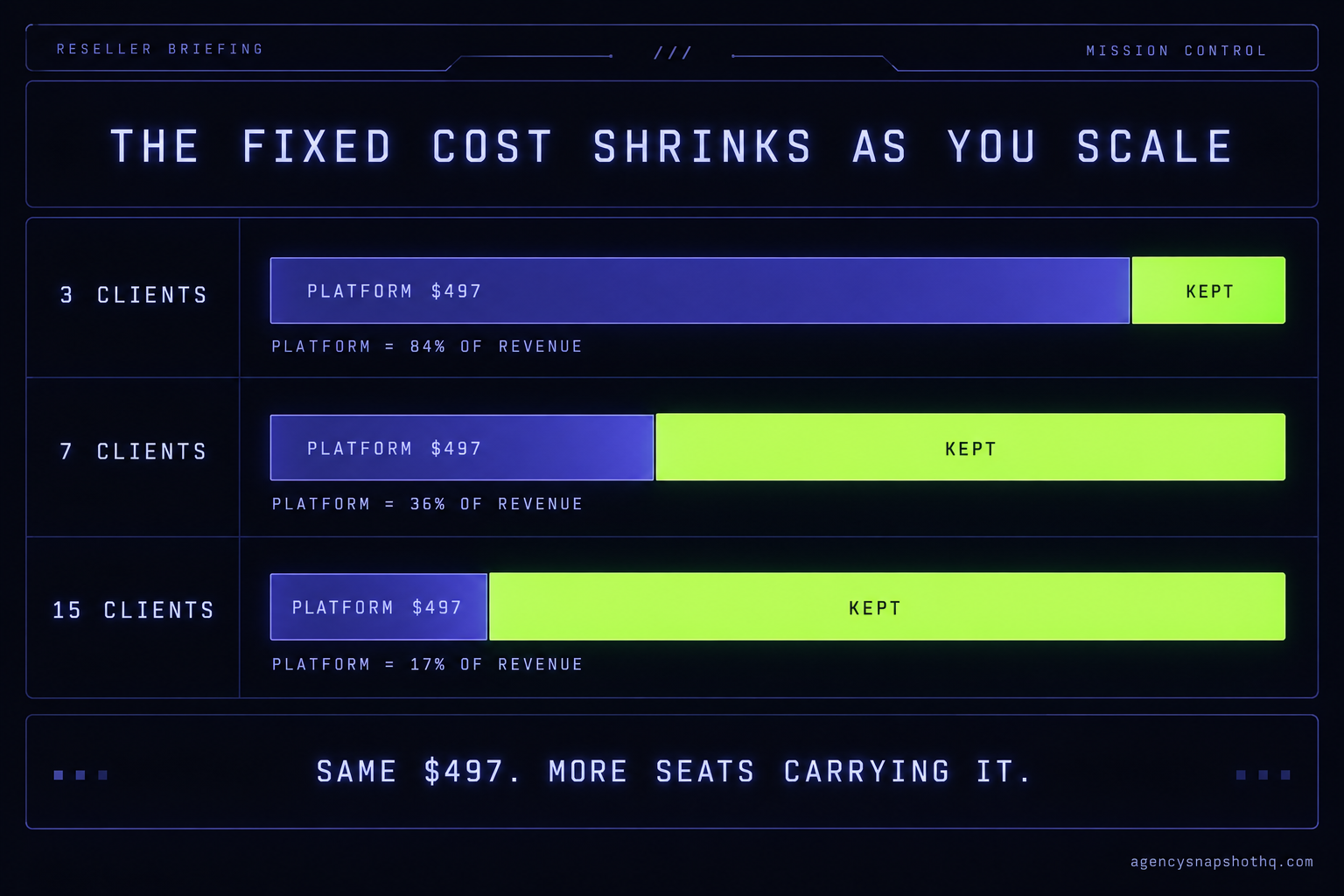
| Clients | Revenue at $197/mo | Less $497 platform | Gross before usage and build | Platform as share of revenue |
|---|---|---|---|---|
| 3 | $591 | $94 | $94 | 84% |
| 7 | $1,379 | $882 | $882 | 36% |
| 15 | $2,955 | $2,458 | $2,458 | 17% |
Read down the last column, because that is the story. At three clients the $497 platform is eating 84 cents of every revenue dollar and you are keeping $94 a month for running a software company. At seven clients the platform is down to about a third of revenue and the thing starts to look like a business. At fifteen it is under a fifth, and the gross is real money. Nothing about the client price changed across those rows. The only thing that changed was how many clients were carrying the same fixed $497.
Now fold in the build cost, because each of those clients needs an account that works, and that is the one place your snapshot spend lands. If you serve a single niche, you buy that niche once and reuse it across every client, since a snapshot licence covers unlimited sub-accounts. The HVAC Contractor Snapshot at $1,490, spread across fifteen clients in that trade, is about $99 a client as a one-time cost, trivial at scale and recovered inside the first month. If you serve several niches, the all-access library at $4,950 a year, which is annual only and never discounted below the catalogue floor, works out to roughly $412 a month across your whole roster, which at fifteen clients is under $30 a client a month. The install itself is free, with 12 hours of dedicated installation support to use within 10 days of purchase, so the build cost is the licence and your own setup time, not an install fee on top.
Put the two together and the shape is clear. The build is a small, mostly one-time cost that amortises fast. The platform is the fixed cost that decides everything, and it is beaten by volume, not by price. A reseller who signs three clients at $497 each is in better shape than one who signs three at $197, but both are still fighting the same fixed cost with too few seats. The honest read of the table is that SaaS mode is a volume model wearing a software costume, and the number to forecast before you turn it on is not your price. It is how many clients you can actually sign this quarter.
The objections worth taking seriously
If the arithmetic made you cautious, good. Here are the arguments against the easy version of this, including the one against buying anything from us.
“I will just build each client’s snapshot myself and skip the library.” For a single niche, with the hours to finish and maintain the build, this is a legitimately cheaper route and you should take it. The cost is not the first build, it is the fifteenth, when a change to your master plan has to reach every live sub-account and the versions have quietly drifted apart. Reselling multiplies the maintenance problem because every account is a paying customer who notices when their copy behaves differently from the plan you advertised. If you have one niche and the discipline to version it, build it yourself. If you have several, or you would rather spend the hours selling, a finished library or a scoped SaaS build is the trade you are actually making.
“SaaS mode is clearly a scale play, so why would I start now?” You might not. That is the honest answer. If your pipeline is three clients and a hope, the $497 is a cost you are paying to feel like a software company, and the money is better spent on the done-for-you work and agency account setup that pays now. Turn SaaS mode on when the pipeline is real enough that the fixed cost disappears into the revenue, not before. Nothing in this model rewards turning it on early.
“Why buy a snapshot from you when HighLevel hands out SaaS snapshots and there are free ones everywhere?” Because the risk you are managing in SaaS is churn, and churn is set by what the client finds when they log in. A starter or free snapshot gets you a shell: the structure is there, the per-niche wiring and the registration are not. In done-for-you that gap is a fixable annoyance. In SaaS it is a cancelled subscription, because the client self-onboards into the gap and leaves. If you only serve one niche and can finish the build yourself, the free route is honestly fine and you do not need us. The moment you are reselling across niches at volume, the cost of a blank account logging in is higher than the cost of a finished one, and that is the only reason the catalogue exists.
“Rebilling a markup on usage feels like nickel-and-diming my clients.” Then do not mark it up. Rebilling at cost is a supported setup, and plenty of resellers pass usage through at exactly what it costs and make their margin on the subscription alone. The thing you cannot skip is turning rebilling on at all, because the alternative is not a kindness to your client, it is a silent bill to you. At-cost rebilling is the floor. A markup is a choice. Paying your clients’ usage yourself is just the default you forgot to change.
The short version is the one the operator on the call reached on his own, once the invoice made sense. SaaS mode is not a margin upgrade on an account you already have. It is a second product with a fixed cost of entry, billing plumbing that bills you by default, and a build quality that decides your churn. Run the table before you flip the switch, turn rebilling on before anyone sends, and attach a build you would be happy to log in to yourself. Do those three things and the $497 becomes the cheapest part of the business. Skip them and it becomes the first month you spent paying for the privilege of reselling your own usage.